Although migration has historically played a transformative role in shaping economic, social and cultural landscapes, its benefits are increasingly reducing, according to the International Organization for Migration (IOM).
The World Migration Report 2026 released on May 5, 2026 showed that the persisting marginalisation of migrants throughout the migration cycle, growing inequality in mobility, narrowing of regular migration pathways and weaponisation of migration in political discourse has threatened the role of migration in development.
The report highlighted the continued importance of migration in the global economy alongside emerging challenges.
By mid-2024, the number of international migrants reached 304 million, accounting for 3.7 per cent of the global population. The number of migrant workers has also risen significantly, increasing by more than 30 million between 2013 and 2022.
These trends underscore migration’s growing role in supporting labour markets, addressing skill shortages and fostering innovation worldwide. Migrants contribute not only through their labour but also through financial transfers and transnational networks that strengthen both origin and destination economies.
Benefits of migration
One of the most significant contributions of migration is through remittances. In 2024, global remittance flows are projected to reach $905 billion, with $685 billion directed to low- and middle-income countries.
These flows now surpass official development assistance and foreign direct investment combined, making them a vital source of external financing for developing economies. At the household level, remittances improve access to education, healthcare and nutrition, thereby enhancing human capital and reducing poverty.
Beyond financial contributions, migration facilitates the exchange of knowledge and skills. Migrants transfer both formal expertise and experiential knowledge, boosting productivity and innovation across borders.
Diaspora engagement further amplifies migration’s development impact. Diaspora communities play a critical role as economic and cultural bridges. They promote trade, investment, and entrepreneurship while also contributing to social development through educational, healthcare, and cultural initiatives.
Uneven access, rising displacement
However, the report emphasises that access to migration opportunities remains highly uneven. High-income countries tend to offer more structured and regular migration pathways, while individuals from lower-income countries face greater barriers.
At the same time, global displacement has reached unprecedented levels. By the end of 2024, over 120 million people were forcibly displaced, including refugees, asylum seekers and internally displaced persons, with 83.4 million displaced within their own countries. These movements are driven by conflict, environmental stress, and structural inequalities, requiring both humanitarian and long-term development responses.
Migration gains at risk
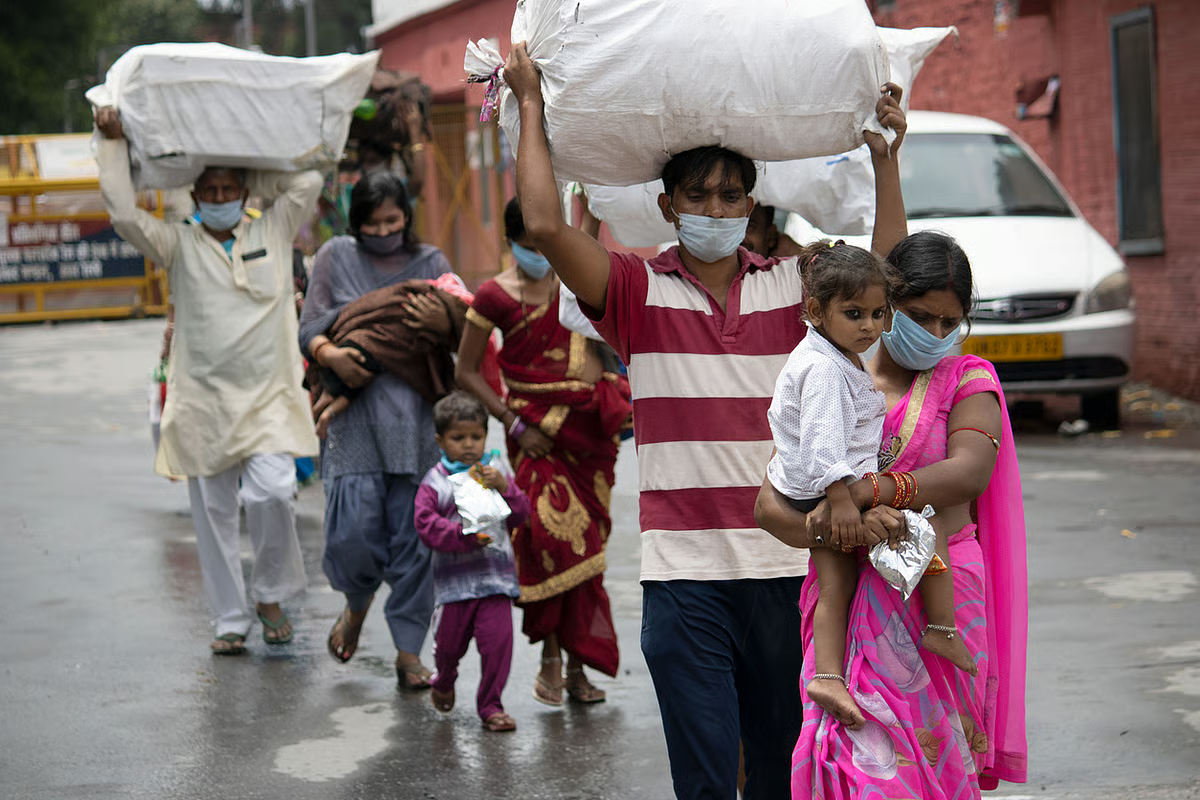
Despite its benefits, migration is increasingly politicised and restricted. Limited access to safe and regular migration pathways pushes many migrants into irregular routes, exposing them to exploitation and life-threatening conditions. Dangerous routes, such as those across the Mediterranean, continue to claim thousands of lives annually.
Survivors often face abuse, poor health conditions and limited economic opportunities, which diminish migration’s positive developmental impact.
Regular pathways for migration are the mechanisms that enable people to move to, enter, stay in, exit or re-enter a country or territory in an authorised manner along their migration journey.
The African Union Commission has framed regular pathways as a way to provide young people with opportunities and an alternative to irregular migration in the Migration Policy Framework for Africa.
The report called for urgent action to safeguard migration as a global public good. Key recommendations include expanding safe and regular pathways, reducing remittance costs, supporting skills mobility and strengthening reintegration policies.
It also emphasised the need for enhanced regional cooperation, improved data systems, and inclusive, evidence-based policymaking to ensure migration continues to benefit societies worldwide.